
What Is a Failsafe Actuator and Why Is It Critical for Emergency Valve Control?
Updated: Aug 12
A power failure does not automatically place an industrial valve in a safe condition. A conventional electric actuator may stop immediately, leaving the valve partly open while fluid continues to move. In cooling, chemical, fuel, or water systems, that uncertain position can increase risk.
A failsafe actuator provides a defined response. Using stored energy, it moves the valve to a predetermined position without waiting for manual intervention.
What Is a Failsafe Actuator?
A stored-energy fail-safe actuator completes a predefined emergency action after normal power is lost. Depending on the hazard analysis, the required failure action may be fail-open, fail-closed, or fail-in-place. Fail-in-place is normally a holding function rather than a powered emergency stroke.
It must have enough energy and torque to reach the specified endpoint under real operating conditions, including pressure, friction, temperature, and valve ageing.
How Fail-Safe Valve Positioning Differs from Standard Actuation
A standard electric actuator depends on incoming power. Once power is lost, the valve normally stops near its current position. A fail-safe electric actuator includes stored energy for an emergency stroke.
Evaluation point | Standard actuator | Failsafe actuator |
Power-loss response | Stops moving | Moves to a preset position |
Emergency energy | Normally unavailable | Stored internally or mechanically |
Final position | May be uncertain | Defined during design |
Typical use | Routine automation | Safety-critical control |
This difference changes the behavior of the complete valve assembly during an outage.
Fail Open, Fail Closed, and Fail in Place Explained
Fail-open means the valve moves to the fully open position, which may be required when cooling water, ventilation, or a designated bypass or vent path must remain available. It is not a substitute for a certified pressure-relief device.
Fail-closed drives the valve to the closed position to isolate or restrict fuel, chemicals, hazardous media, or uncontrolled water flow. Actual shutoff tightness depends on the valve’s leakage rating, seat condition, differential pressure, and service conditions.
Fail-in-place means the actuator is designed to hold the valve at the position existing when the specified failure occurs, subject to the holding capability of the gearbox or brake and the applied process torque. It should be selected only when the risk assessment accepts the possible resulting valve position.
How Does a Supercapacitor Failsafe Actuator Work?

A supercapacitor failsafe actuator stores electrical energy during normal operation and releases it when the main supply is lost. At AOITEC, our built-in supercapacitor design enables automatic valve positioning without external emergency power. It can drive the valve open or closed according to the configured requirement.
Normal Operation and Automatic Energy Charging
During normal service, the actuator receives open and close commands while the supercapacitor charges and remains ready.
1. The actuator performs normal quarter-turn movement.
2. The supercapacitor stores energy for the emergency stroke.
3. The control circuit monitors the incoming supply.
Integrated charging means the backup function does not depend on temporary power being connected after an outage.
What Happens the Moment Power Is Lost
The emergency sequence follows five steps:
1. The actuator detects loss of supply.
2. The control circuit activates the preset direction.
3. Stored energy powers the drive system.
4. The actuator rotates the valve toward the safe position.
5. Movement stops at the open or closed limit.
This response helps unattended systems reach a known condition automatically.
Why Supercapacitor Energy Storage Fits Emergency Valve Control
Supercapacitors suit applications needing a short, controlled burst of energy rather than long-duration backup power. Compared with conventional battery-based solutions, AOITEC’s design offers faster charging, longer service life, and lower maintenance requirements.
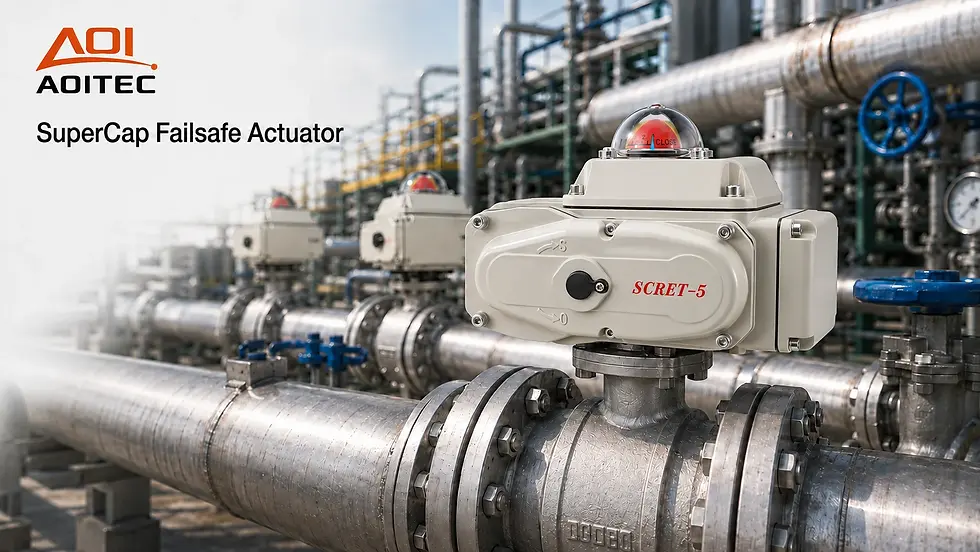
An integrated supercapacitor return actuator can also simplify compact OEM valve assemblies, packaged skids, utility stations, and installations with limited access.
Our broader engineering focuses on compact integration, dependable output, durability, and reliability. AOITEC develops BLDC, high-speed, and supercapacitor failsafe actuators for different automation and safety needs.
Why Is a Failsafe Actuator Critical for Emergency Valve Control?
Emergency control is not always about closing a valve. It is about moving it to the correct position for the hazard. The wrong response can interrupt cooling, trap pressure, cause overflow, or continue feeding a dangerous process.
Safety and Process Risks When a Valve Stops in the Wrong Position
Potential consequences include:
· Continued release of hazardous or combustible fluid
· Loss of cooling water
· Overflow or backflow
· Product contamination
· Pressure or temperature escalation
· Equipment damage and extended shutdowns
A fail-safe valve actuator does not replace alarms, shutdown logic, independent pressure-relief protection, or other safeguards. It provides final-element action when the configured trip condition is detected, either locally through loss-of-power detection or through an external emergency-shutdown command.
How Controlled Emergency Positioning Protects People, Equipment, and Flow Systems
A predictable endpoint helps contain an incident and supports a controlled restart. A fail-closed action can isolate a chemical line, while a fail-open action can maintain cooling as other equipment shuts down.
Operators can plan around a confirmed valve position rather than an uncertain partially open valve.
How to Select the Right Fail-Safe Valve Actuator
Selection should start with the process requirement. The actuator must move the actual valve under the worst credible condition and complete the stroke using available emergency energy.
Define the Required Safe Position
Before sizing the actuator, determine:
1. What event triggers the emergency action?
2. Must the flow stop, continue, or be redirected?
3. Is the required failure position fully open, fully closed, fail-in-place, or a validated intermediate position?
4. What should happen when power returns?
5. How will the function be tested?
These questions prevent the assumption that “failsafe” always means “fail closed.”
Match Valve Type, Torque, Stroke Time, and Power Supply
Key factors include valve type, torque profile, differential pressure, supply voltage, stored-energy capacity, and the required emergency stroke time. In liquid service, the stroke time must also be checked against pressure-surge and water-hammer limits; faster operation is not always safer.
Ball and butterfly valves are quarter-turn devices, but their torque profiles differ. Deposits, ageing seals, temperature changes, and long idle periods can increase resistance. Use the valve manufacturer’s maximum required torque for the specified service, apply a documented sizing factor, and verify that the actuator’s maximum output torque does not exceed the valve’s maximum allowable stem torque.
AOITEC manufactures electric actuators and integrated valve solutions for quarter-turn control in water treatment, HVAC, power generation, process systems, and OEM equipment.
Consider Lifecycle, Installation Space, and Maintenance
Buyers will need to consider charging time, period for inspection or testing, environmental protection, accessibility of wiring, required space for installation, availability of spare parts, and testing of emergency functions.
A maintenance plan should test the following points on the actuator: It detects power loss, delivers enough torque, reaches the right end position, and comes back into the ready position after power has been switched back on.
Where Are Fail-Safe Electric Actuators Commonly Used?
Failsafe actuation is most valuable where power loss affects safety or continuity. Common uses include emergency isolation, cooling-water control, tank valves, chemical dosing lines, utility pipelines, fire-protection systems, and marine fluid control.
Typical Applications for Ball and Butterfly Valves
In water treatment, an emergency actuator may close an inlet valve to prevent overflow or reposition a valve to protect pumps. In power generation, the actuator may support cooling, water treatment, desulfurization, or auxiliary systems. AOITEC supplies solutions for these sectors, where reliability and reduced manual intervention are especially important.
Final selection should reflect actual torque, emergency position, environment, stroke time, and maintenance strategy.
FAQ
Q: What is a failsafe actuator and how does it work?
A: A failsafe actuator moves a valve to a predetermined position when normal power is lost. Stored electrical or mechanical energy completes the emergency stroke instead of leaving the valve in an uncertain position.
Q: What is the difference between a fail-safe actuator and a standard electric actuator?
A: A standard electric actuator normally stops and remains at its current position when power is lost, subject to its holding mechanism and process torque. A fail-safe actuator uses stored energy to move the valve to the configured safe position, typically fully open or fully closed.
Q: Should a fail-safe valve actuator be fail-open or fail-closed?
A: The choice depends on process risk. Fail-closed isolates flow. Fail-open is appropriate when cooling, pressure relief, ventilation, or another protective service must continue.
Q: How does a supercapacitor failsafe actuator operate during a power outage?
A: Its built-in supercapacitor charges during normal operation. After power loss, stored energy drives the actuator to its preset emergency position without an external backup supply.
Q: Can a fail-safe electric actuator be used with ball and butterfly valves?
A: Yes. Quarter-turn failsafe actuators can operate ball and butterfly valves when the mounting interface, torque, stroke time, power supply, and environmental rating are correctly matched.


Comments