
High Speed Actuator in Industrial Applications
Updated: Aug 12
In automated production, a delay of only a few seconds can upset material dosing, flow diversion, equipment sequencing, or emergency isolation. Standard valve actuators suit many routine operations. Some processes require the valve to reach its open or closed position much faster.
A high speed actuator serves these time-sensitive applications. Rather than simply raising motor speed, an effective actuator must join rapid movement with sufficient torque, stable control, mechanical durability, and dependable valve seating. This article focuses on electric rotary actuators for quarter-turn valves.
What Makes a High Speed Actuator Different in Valve Automation?
How Does a High Speed Quarter Turn Actuator Operate?
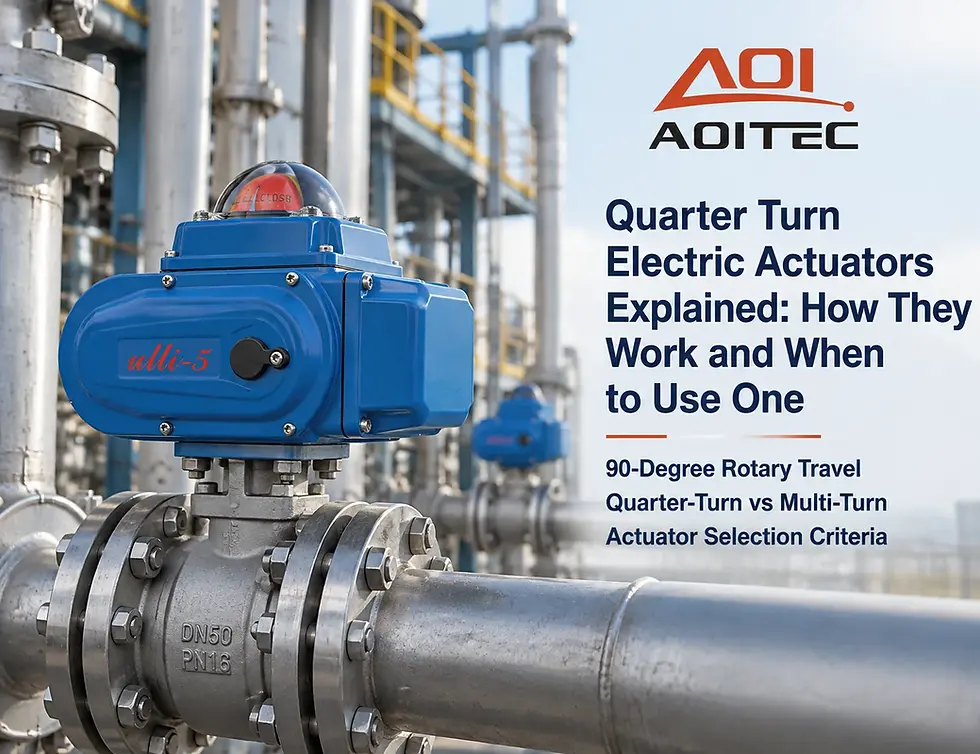
A high speed quarter turn actuator converts electrical energy into rapid rotary movement. After the actuator receives an open or close command, the motor drives a reduction gear system. The gearbox transfers torque to the output shaft. The output shaft rotates the connected valve stem.
End-of-travel limit controls normally de-energize the motor when the commanded position is reached, while torque or overload protection prevents excessive load if the valve stalls or becomes obstructed. Whether the valve is limit-seated or torque-seated should follow the valve manufacturer’s requirements. Feedback signals can then report the valve status to a PLC, distributed control system, or local control panel.
This operating principle makes a high-speed part-turn actuator primarily suitable for quarter-turn ball valves and butterfly valves. Plug valves, diverter valves, and rotary dampers may also be considered only when the required torque profile, travel angle, mounting interface, shaft dimensions, and actuator manufacturer approval have been confirmed.
Why Must Speed Be Balanced with Torque and Protection?
Increasing speed creates additional demand on the motor, gears, valve stem, and sealing components. A valve may require relatively high torque when the valve first begins moving. The valve may require lower torque during travel. The valve may require increased torque again when the valve reaches the seated position.
Selecting an actuator only according to normal running torque may therefore result in incomplete opening, incomplete closure, or repeated overload conditions.
Engineers should consider:
1. Breakaway torque at the start of movement
2. Running torque during rotation
3. Seating torque at the end of travel
4. Differential pressure across the valve
5. Media buildup, seal friction, or temperature effects
6. Required cycles per hour
7. Available electrical power
Protective control functions are also important. Overload prevention helps reduce damage when a valve becomes obstructed or unusually difficult to move. Stable control near the travel limits can reduce mechanical shock and support more repeatable positioning.
Where Do High Speed Actuators Deliver the Most Value?
Fast actuation is valuable when valve timing directly affects safety, production continuity, or process accuracy. Fast actuation is less important in applications where a valve changes position only occasionally and a slower movement has no effect on the process.
High-Speed Production, Dosing, and Material Routing
Automated production lines often coordinate valves with conveyors, mixers, hoppers, pumps, and packaging equipment. A slow valve can delay the next machine cycle or increase batch cutoff error. However, fast on-off actuation should be combined with flow, weight, level, or position feedback when dosing accuracy is important. It does not replace a modulating valve or closed-loop control system when continuous flow regulation is required.
Common applications include:
· Powder and plastic pellet conveying
· Ingredient dosing
· Liquid batching
· Mixing and blending
· Cleaning and purge cycles
· Process-water switching
· Automated packaging equipment
· Rapid material diversion
For example, consider a plastics processing line that routes raw material from several storage points to multiple machines. Each diverter valve must change position before the next material batch enters the pipeline. A fast acting electric valve actuator can shorten the switching interval and reduce the risk of material being directed to the wrong destination.
Rapid operation must still be coordinated with sensors and PLC logic. The control system should confirm that the valve has reached its commanded position before starting the next process step.
Safety Isolation and Rapid Process Response
In critical systems, the purpose of rapid actuation is often to limit the consequences of an abnormal condition. A control command may be triggered by excessive pressure, unusual temperature, equipment failure, leakage detection, or another process alarm.
Typical applications include:
· Emergency shutdown systems
· Oil and gas pipeline isolation
· Chemical process switching
· Power-plant cooling systems
· Fuel-handling systems
· Industrial water networks
· Marine fluid-control systems
An industrial case can be seen in storage, loading, and pipeline operations. Operators may need to replace manual valve operation with remote electric control while maintaining the ability to isolate a process quickly. A properly selected high-speed valve actuator can shorten commanded isolation time and allow remote valve operation from a safer location. For emergency shutdown service, however, the complete final element must also meet the required fail-open or fail-close position, power-loss response, diagnostic coverage, proof-test requirements, and applicable SIS or SIL specifications.
How Does a High Speed Electric Actuator Compare with Other Options?
Electric, pneumatic, and solenoid-based solutions can all provide rapid fluid control. These solutions are designed for different system requirements.
Energy source | Electrical power | Compressed air | Electrical power |
Typical function | Rotates a separate valve | Rotates or moves a valve | Directly opens or closes an internal passage |
Position feedback | Easy to integrate | Often requires accessories | Usually limited |
Air supply required | No | Yes | No |
Suitable valve range | Model-dependent, including larger quarter-turn valves | Broad valve range | Commonly used for smaller flow paths |
Installation needs | Wiring and control connection | Air tubing, preparation, and control valves | Electrical connection |
Main advantage | Integrated control without compressed air | Very rapid action where air is available | Compact and fast switching |
High Speed Electric Actuator vs Pneumatic Actuator
Pneumatic actuators are widely used for rapid valve operation. Pneumatic actuators can be highly effective in facilities that already have a stable compressed-air network. Performance depends on air pressure, tubing size, air quality, control valves, and leakage management.
A high speed electric actuator removes the need for an air compressor, air preparation equipment, and pneumatic piping. A high speed electric actuator can also simplify position feedback and connection to PLC-based systems.
The best choice depends on:
· Required operating time
· Available utilities
· Valve torque
· Installation space
· Control architecture
· Maintenance capability
· Environmental conditions
· Required feedback signals
Electric actuation is not automatically faster than pneumatic actuation. The advantage is that electric actuation can provide rapid rotary movement through an electrically integrated package without depending on a compressed-air infrastructure.
Fast Acting Electric Valve Actuator vs Solenoid Valve
A solenoid valve and an electric valve actuator perform different functions. A solenoid valve contains its own flow passage and uses an electromagnetic coil to open or close that passage. An actuator, by contrast, moves a separate process valve.
Solenoid valves are useful for compact, fast-switching duties. Solenoid valves may not suit larger pipelines, high flow rates, abrasive media, or applications requiring a specific ball, butterfly, or plug valve.
A fast acting valve actuator offers greater flexibility because engineers can select the valve body, seal material, pressure class, and flow characteristics separately from the actuator. This selection makes actuator-driven valves more suitable for many industrial pipelines and process systems.
How Should Engineers Select a High Speed Quarter Turn Actuator?
A reliable selection begins with the valve and process data. Choosing the fastest available actuator before confirming these conditions can result in insufficient torque, unnecessary mechanical stress, or unstable pipeline behavior.
Match Operating Time and Torque to the Valve
Before requesting an actuator recommendation, collect:
1. Valve type and nominal diameter
2. Valve stem and mounting dimensions
3. Required rotation angle
4. Breakaway, running, and seating torque
5. Maximum differential pressure
6. Process medium and temperature
7. Required opening and closing time
8. Operating cycles per hour
9. Normal and emergency valve positions
The actuator should provide enough output torque to move the valve under the most demanding expected condition. A suitable engineering margin should also be considered because seal friction, deposits, pressure changes, and long-term wear can increase torque requirements.
Pipeline behavior must also be reviewed. Closing a liquid-control valve too quickly may create a pressure surge or water hammer. In such systems, the target speed should be determined through hydraulic analysis rather than assuming that the shortest closing time is always best.

AOITEC’s High Speed Actuator is developed for quarter-turn ball and butterfly valves. A confirmed configuration can achieve an operating time of up to two seconds at 50 Nm output. This configuration makes the actuator suitable for applications that require rapid valve movement. Actual selection should still be based on the complete valve and process requirements.
Verify Control, Power, Mounting, and Environment
Mechanical sizing is only one part of actuator selection. Engineers should also confirm:
· On-off or modulating operation
· Power supply
· Input and output signals
· Open and closed position feedback
· PLC compatibility
· Required duty cycle
· Manual operation requirements
· ISO 5211 mounting compatibility
· Ambient temperature
· Moisture, dust, corrosion, and vibration exposure
· Cable-entry and installation-space requirements
How Does AOITEC Support Fast Acting Valve Automation?
AOITEC specializes in electric valve actuators, electric valves, and automation-control solutions.
AOITEC high-speed technology is designed for ball valves and butterfly valves used in time-sensitive industrial processes. Compared with conventional actuator arrangements, the technology supports significantly faster valve response while retaining the torque and control functions required for industrial automation.
AOITEC also applies compact actuator design, direct valve mounting, control-system integration, and protective functions such as overload prevention. These characteristics help reduce installation space and support reliable operation in automated equipment.
FAQ
Q: What is a high speed actuator used for in industrial applications?
A: A high speed actuator rapidly opens, closes, or repositions an industrial valve. Such an actuator is commonly used in emergency isolation, material routing, dosing, batching, production sequencing, pipeline switching, and other processes where valve timing affects safety or efficiency.
Q: How fast should a high speed quarter turn actuator operate?
A: The correct speed depends on the process. Engineers must consider valve torque, pipeline pressure, valve size, operating frequency, control sequence, and pressure-surge risk. The fastest available actuator is not always the safest or most reliable choice.
Q: Is a high speed electric actuator faster than a pneumatic actuator?
A: Pneumatic actuators can be extremely fast, especially where a suitable compressed-air system is already installed. A high speed electric actuator can also provide rapid movement while simplifying electrical control, feedback, and installation in facilities without compressed air.
Q: Which valves can use a high speed part-turn actuator?
A: A high speed part-turn actuator is commonly paired with ball valves, butterfly valves, plug valves, diverter valves, and rotary dampers. The valve torque, stem dimensions, mounting interface, and required travel angle must be confirmed before installation.
Q: Can a fast acting valve actuator cause water hammer?
A: Yes. Rapid valve closure can create pressure surges in some liquid pipelines. Engineers should evaluate flow velocity, pipe length, valve characteristics, and system pressure before setting the closing time.


Comments