
Understanding Modbus Communication in Quarter-Turn Electric Actuators: A Complete Guide
- Jun 11
- 6 min read
What is Modbus and Why Does It Matter for Valve Automation?
The Basics of the Modbus Protocol
Industrial automation depends on clear communication between supervisory computers and field devices. Modbus remains a common serial communication protocol, first released in the late 1970s for programmable logic controllers. Over many years, the protocol has grown into a standard choice in industrial automation thanks to its open design, simple structure, and steady performance. In fluid control work, this protocol lets a central client device, such as a programmable logic controller or a supervisory control and data acquisition system, exchange information with several server devices, such as quarter-turn electric actuators, across one shared network.
The client-server setup works when the central controller sends requests for information or issues commands. The specific actuator that receives the address, then replies. This digital exchange supports accurate automated pipeline control and process management without any need for a physical operator to check each valve by hand. Facilities, therefore, combine equipment from many brands and types into one unified electronic control platform. The platform, in turn, supports intelligent actuator control along with system integration and advanced automation functions.
Modbus RTU vs. TCP: Choosing the Right Standard for Your Actuators
When engineers add quarter-turn electric actuators to a plant network, they normally select between two main versions of the protocol. These versions are Remote Terminal Unit (RTU) and Transmission Control Protocol (TCP). Knowledge of the differences is important for designing an efficient network layout.
Modbus RTU works across serial lines, most often RS-485. The method sends data in compact binary form, which brings high efficiency to industrial settings where packets stay small and transmission stays strong. Devices link together in a daisy-chain layout, so the communication cable runs from the master controller to the first actuator, then continues to the next actuator and onward.
Modbus TCP encapsulates the Modbus application protocol data unit (ADU) within standard TCP/IP packets. Communication can therefore move over standard networking equipment that includes RJ45 cables, Ethernet switches, and IP addresses.
Comparison of the two standards:
Protocol Variation | Communication Medium | Topology Type | Maximum Distance | Typical Application |
Modbus RTU | RS-485 serial cable | Daisy chain | Up to 1200 meters without repeaters | Long-distance field actuator networks |
Modbus TCP | Standard Ethernet cable | Star or tree configuration | 100 meters between switches | Plant-wide integration and modern IT infrastructure |
Selection of the right standard rests completely on the facility layout. Older plants that cover large physical distances between processing units often prefer the RTU serial setup. Newly built automated facilities commonly choose TCP because the version supplies faster data rates and a smooth connection with current IT systems.
Core Advantages of Using Modbus in Quarter-Turn Electric Actuators
Simplified Wiring and Reduced Installation Costs
The usual method for automating electric valves depends on analog signals, in particular the 4-20mA standard. Inside an analog system, each actuator needs its own dedicated multi-core cable that runs all the way back to the central control panel. One wire pair sets the position command while another wire pair carries the position feedback. When a facility operates fifty actuators, the requirement becomes fifty separate cable runs that call for large cable trays, heavy labor, and complicated troubleshooting.
Movement to a digital serial network changes this layout in a basic way. One twisted-pair communication cable can link dozens of actuators inside a single series. The sharp drop in copper wiring leads directly to lower material costs and much quicker installation times. In addition, specialized terminal block designs raise wiring convenience, connection stability, and installation efficiency while strengthening overall system reliability. Smaller amounts of physical wiring also create fewer termination points that might loosen or corrode during a 15- to 20-year service life.
Real-Time Data Monitoring and Predictive Diagnostics
Analog systems stay strictly limited in the kind of information they can send. A 4-20mA signal gives the controller only the present physical position of the valve. The signal cannot share the internal health of the motor, the internal temperature of the housing, or particular error codes.
Digital communication opens two-way data exchange. A central controller can steadily poll the actuator for a broad range of diagnostic parameters. Operators can access holding registers that display real-time seating torque profile, execution time, and cumulative travel distance, the total number of operation cycles, and specific fault alarms such as motor over-temperature or signal loss. This feature moves maintenance strategies from reactive approaches to predictive approaches. When an operator sees the needed torque to close a butterfly valve rise slowly across several months, the operator can plan maintenance on that exact valve before an unexpected mechanical failure takes place and thereby avoid expensive unplanned downtime.
Key Considerations for Integrating Modbus Actuators into Control Systems
Overcoming Common Industrial Interference
Industrial environments carry built-in electrical noise. Large motors that start variable frequency drives and heavy machinery create electromagnetic interference that can quickly damage low-voltage digital signals moving along a serial network. When data packets suffer damage, actuators can miss important movement commands or send back wrong feedback.
Facilities protect network integrity by following strict installation rules. Communication lines must employ shielded twisted-pair cables. The physical twisting of the wires cancels induced electromagnetic fields, while the outer shield catches interference and sends it safely to ground. In addition, the physical build of the actuator serves an essential part in signal protection. Equipment built with a die-cast aluminum housing reduces electromagnetic interference. Correct grounding of both communication shields and actuator housings remains required to guarantee clear, continuous data transmission across the network.
Network Topology and Distance Limits
The design of a reliable RS-485 serial network needs close focus on physical limits. A standard segment can normally handle up to 32 separate nodes, which include the master controller and 31 slave actuators. When a project needs more devices, engineers install signal repeaters that strengthen the data packets and let the network grow to 247 total addresses.
Distance forms another vital factor. The maximum theoretical distance for a standard serial network reaches about 1200 meters. However, this distance is inversely proportional to the communication speed. Higher baud rates permit faster data updates yet cut the usable maximum distance of the cable run. To stop communication errors that come from signal reflection at the end of a long cable run, terminating resistors must sit at the physically furthest devices on the network. Without those resistors, the digital pulses can reflect back along the cable and cause waveform distortion or packet corruption, which leads to intermittent communication dropouts.
AOITEC Solutions: Reliable Quarter-Turn Actuators with Seamless Modbus Connectivity
Engineered for Global Automation Standards
AOITEC operates as a high-tech enterprise focused on the research, development, and manufacturing of electric actuators, electric valves, and automatic control systems with more than 25 years of industry experience. The company stands as a dependable solution provider in the global industrial automation market. Product portfolio design allows flawless integration into advanced industrial automation systems that call for programmable logic controllers or remote monitoring.
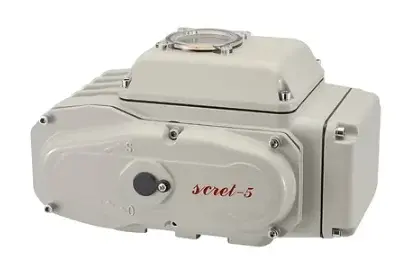
AOITEC's Intelligent Modbus RTU Modulating Actuator
AOITEC's intelligent Modbus RTU modulating actuator is designed for seamless integration and precise operation, featuring:
RS485 Modbus RTU Communication
4-20mA Modulating Control
Local/Remote Selector Switch
PLC / DCS / SCADA Integration
These core capabilities ensure reliable, two-way data exchange and flexible control routing within any modern industrial facility.

FAQ
Q: Why should I choose Modbus over standard 4-20mA analog control for quarter-turn electric actuators?
A: Although 4-20mA analog control remains a reliable standard for continuous positioning commands, it is limited to point-to-point, unidirectional communication and needs separate multi-core cables for each field device. Modbus forms a digital communication standard that permits two-way data exchange. The arrangement means one daisy-chained network cable can manage the electric actuator while the cable sends important diagnostic data, such as internal temperature, exact position, and fault alarms, back to the supervisory system, which greatly lowers installation costs and supports predictive maintenance.
Q: What is the maximum distance for Modbus RTU communication in electric actuators?
A: When standard RS-485 serial communication architecture is in use, an RTU network can send data reliably up to 1200 meters without any signal repeater. However, this maximum distance rests heavily on the chosen baud rate and the quality of the shielded twisted-pair cables in service. Industrial environments need high-quality shielding to keep electromagnetic interference from breaking the digital signals across long distances.
Q: How many quarter-turn electric actuators can be connected on a single Modbus network?
A: A standard RTU network that runs over RS-485 serial lines can normally support up to 32 devices on one physical segment. The count covers the master controller plus 31 individual actuators. When a facility needs more automated valves, network repeaters can be installed to boost the data signal, which lets the system grow and hold up to 247 total addresses on the same main network.
Q: What are the most common troubleshooting steps for Modbus communication failures in actuators?
A: The most regular reasons for communication failure involve physical wiring problems and software configuration mismatches. First, confirm that the positive and negative communication wires have not been reversed at the terminal block. Next, make certain that the baud rate, parity, and stop bit settings on the actuator match exactly the parameters set inside the master controller. Finally, verify that terminating resistors sit correctly at the physically furthest ends of the serial network to stop signal reflection.
Q: Can Modbus TCP be used directly with quarter-turn electric actuators?
A: Many modern industrial facilities now shift toward TCP architectures that employ standard Ethernet infrastructure instead of traditional serial wiring. Serial RTU networks continue to be very common for field-level valve automation because of their long-distance capabilities. Actuators fitted with Ethernet modules deliver clearly faster data transfer speeds. The modules therefore make integration of remote automated valves into modern plant-wide IT networks and advanced automation systems far simpler.


Comments