
Electric Valve Actuator: The Complete Guide to Types, Selection and Sizing
Updated: 7 hours ago
An electric valve actuator uses electrical power to automate the opening, closing, or positioning of a valve. It replaces manual valve operation with controlled motion, making it possible to integrate valves into automated industrial processes, building management systems, water networks, production equipment, and remote control systems.
For engineers and equipment manufacturers, however, choosing an electric valve actuator involves much more than matching a motor to a valve.
Valve type, required torque, operating angle, control mode, mounting interface, duty cycle, environmental protection, operating speed, and fail-safe requirements can all affect actuator selection.
This guide explains the main types of electric valve actuators, how quarter-turn actuators work, how to select an actuator for a valve, and which actuator technologies are suitable for different industrial applications.
What Is an Electric Valve Actuator?

An electric valve actuator converts electrical energy into mechanical movement to operate a valve.
Depending on the valve and process, the actuator may be required to:
· Fully open or fully close a valve
· Move a valve to an intermediate position
· Continuously regulate flow
· Provide position feedback to a control system
· Operate remotely through a PLC, BMS, or other automation system
· Move the valve quickly during an emergency
· Move the valve to a safe position if electrical power is lost
Electric actuators are widely used because they can provide automated valve operation without requiring a compressed-air supply.
They are commonly found in:
· Water and wastewater treatment
· HVAC and building automation
· Oil and gas
· Chemical and petrochemical processing
· Power generation
· Food and beverage production
· Pulp and paper
· Marine systems
· OEM machinery and skid systems
· Data center cooling systems
The correct actuator depends first on the type of movement required by the valve.
Electric vs Pneumatic Actuators
While pneumatic actuators have traditionally been used in fluid control, electric valve actuators are increasingly becoming the standard for modern industrial automation. When evaluating an electric vs pneumatic actuator, engineers must consider three key areas:
· Cost (Lifecycle vs. Initial): Pneumatic actuators often have a lower initial purchase price. However, they rely on an expensive infrastructure of air compressors, filters, and tubing, which carries high ongoing energy and maintenance costs. Electric actuators require only a power source, significantly reducing long-term operating costs. For example, utilizing advanced brushless DC (BLDC) motor technology enables energy savings of 20% to 60% compared to traditional setups.
· Control and Precision: Electric actuators offer superior precision, especially in modulating applications. They can directly receive 4–20 mA or 2–10 VDC signals to integrate seamlessly with PLCs and Building Management Systems (BMS) without the need for complex I/P (current-to-pressure) transducers or positioners.
· Reliability: Pneumatic systems are vulnerable to air leaks, compressor failures, and moisture freezing in air lines. Electric actuators eliminate these risks. Designed for durability, industrial-grade electric actuators provide long-term stable performance, with a typical service life of 15 to 20 years.
Quarter-Turn vs Multi-Turn vs Linear Electric Actuators
Electric actuators can be broadly classified by their output movement.
Quarter-Turn Electric Actuator
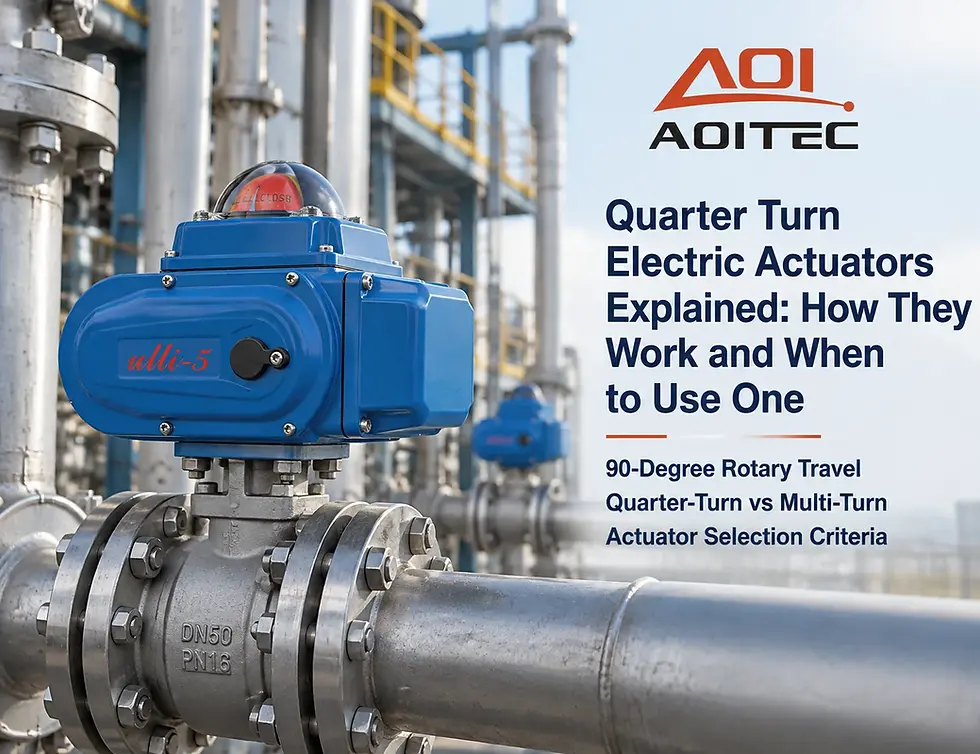
A quarter-turn electric actuator normally rotates approximately 90 degrees between its open and closed positions.
It is commonly used with valves such as:
· Ball valves
· Butterfly valves
· Plug valves and other suitable rotary valves
Quarter-turn actuators are widely used in fluid automation because many isolation and control valves require only a 90-degree rotation.
AOITEC’s core electric valve actuator portfolio focuses on this type of valve automation.
Multi-Turn Electric Actuator
A multi-turn actuator rotates through multiple revolutions.
It is typically required for valves whose stems must rotate several times between fully open and fully closed positions.
Before selecting an actuator, engineers should therefore confirm whether the valve requires quarter-turn or multi-turn movement.
Linear Actuator
A linear actuator produces straight-line movement rather than rotary movement.
Linear actuation is used where the valve mechanism requires axial stem travel instead of rotational movement.
The first selection question should therefore always be: What type of movement does the valve require?
For ball and butterfly valves, the answer is usually a quarter-turn electric valve actuator.
Selection Note: AOITEC’s Quarter-Turn Focus
While we provide this guide to help you understand all actuator types, we believe in being completely transparent about our capabilities. AOITEC is exclusively a quarter-turn electric actuator manufacturer. We do not manufacture multi-turn or linear actuators.
· If you need Quarter-Turn (Ball/Butterfly valves): AOITEC can provide highly optimized, direct-mount solutions.
· If you need Multi-Turn or Linear: We recommend asking your valve manufacturer for paired recommendations, or seeking out brands that specialize specifically in those movements to ensure the safety and reliability of your process.
How Does a Quarter-Turn Electric Valve Actuator Work?
A quarter-turn electric actuator uses an electric motor and internal gear system to generate controlled rotary torque.
That torque is transferred to the valve stem, rotating the valve between its required positions.
In a typical valve automation system, the actuator includes several functional elements:
1. Electric motor to generate movement
2. Gear transmission to convert motor output into the required torque
3. Output drive to connect the actuator to the valve
4. Limit or position control to determine valve travel
5. Electrical control components to receive open, close, or positioning commands
6. Housing and sealing system to protect the actuator from the operating environment
Depending on the actuator design, additional functions may include position feedback, modulating control, automatic calibration, emergency operation, high-speed movement, or intelligent communication.
On/Off vs Modulating Electric Actuators
One of the most important decisions is whether the application requires simple open/close operation or continuous valve positioning.
On/Off Electric Actuator
An on/off electric actuator is used when the valve mainly has two operating positions: Fully Open or Fully Closed.
Typical applications include:
· Pipeline isolation
· Water distribution
· Tank inlet and outlet control
· HVAC isolation
· Equipment switching
· Basic process automation
· OEM machines and skid systems
AOITEC’s Ulli Series is a general-duty on/off electric actuator designed for quarter-turn valves such as ball valves and butterfly valves. It is intended for applications where compact construction and reliable valve opening and closing are the main requirements.

Modulating Electric Actuator
A modulating electric actuator can position the valve between fully open and fully closed.
Instead of simply switching between two end positions, it can regulate valve position according to a control signal.
This is required when the valve is being used to control variables such as:
· Flow
· Pressure
· Temperature
· Cooling water
· Process fluid quantity
AOITEC’s Digicon Series is designed for quarter-turn ball and butterfly valves that require precise positioning, feedback, and a higher level of automation. Typical applications include process control, dosing systems, power generation, water treatment, HVAC, PLC-controlled automation, and remote monitoring systems.

On/Off or Modulating: Which One Should You Choose?
A simple rule is:
Application Requirement | Actuator Type |
Valve only needs to open and close | On/Off |
Valve must stop at intermediate positions | Modulating |
Flow must be continuously regulated | Modulating |
Basic pipeline isolation | On/Off |
PLC/BMS positioning control | Modulating |
Process variable regulation | Modulating |
For many projects, identifying the required control mode immediately narrows down the appropriate actuator series.
How to Select an Electric Valve Actuator
Selecting an actuator should be approached as a complete valve-and-actuator system rather than simply choosing a torque number from a catalog.
The following factors should be checked.
1. Identify the Valve Type
Start with the valve itself.
For a quarter-turn electric actuator, typical valve types include:
· Ball valve
· Butterfly valve
· Suitable rotary plug valve
· Other 90-degree rotary valve designs
Valve type matters because different valve designs have different torque characteristics.
A ball valve and a butterfly valve of similar nominal size should not automatically be assumed to require the same actuator.
The actual valve manufacturer’s torque information should be used whenever available.
2. Confirm the Required Operating Torque
The actuator must generate sufficient output torque to move the valve reliably under actual operating conditions.
Do not select an actuator only according to valve diameter.
The correct selection should consider information such as:
· Valve operating torque
· Valve size
· Valve design
· Operating pressure
· Process conditions
· Required opening and closing performance
For final valve actuator sizing, the valve torque data and actual operating conditions should be confirmed before selecting the actuator model.
Where valve torque information is available, apply a suitable safety factor (typically 20% to 30%, depending on the fluid media) and choose an actuator with sufficient output capacity for reliable operation rather than operating continuously at the edge of its capability.
If the torque requirement is uncertain, send AOITEC the valve specifications and operating conditions for actuator selection support.
3. Check the Valve Mounting Interface
Mechanical compatibility is just as important as torque. An actuator must connect correctly to the valve mounting flange and valve stem. An ISO 5211 actuator is widely used for quarter-turn valve interfaces because it provides a standardized mounting arrangement. AOITEC enhances this with a truly bracket-free, ultra-compact design that allows for direct valve installation, keeping height and weight to only 35% of typical models.
AOITEC uses a compact direct-mount design based on ISO 5211. A major design feature is the elimination of the conventional internal bracket arrangement used in many actuator installations.
This bracket-free electric actuator design enables more direct integration between the actuator and valve, which can help:
· Reduce overall installation height
· Reduce weight
· Save installation space
· Simplify valve-actuator integration
· Improve suitability for compact equipment
· Reduce complexity during installation and maintenance
This is particularly useful for OEM equipment, packaged systems, skid systems, building services, and other installations where available space is limited.
Before ordering, always confirm both: ISO 5211 flange compatibility and valve stem/drive dimensions
4. Choose the Correct Control Mode
Next, determine how the automation system will control the valve.
For basic open and close commands, an on/off actuator is normally sufficient. For continuous valve positioning, a modulating actuator or suitable control package is required.
AOITEC also provides control technology for applications requiring automatic calibration and position control. For example, the FACP-11 Auto Setting Control Pack is designed to simplify actuator setup and calibration and can support control signals such as 4–20 mA DC or 2–10 VDC.
This type of control capability is useful when actuators need to integrate with PLCs, process control systems, or building automation systems.
5. Consider Duty Cycle and Operating Frequency
Not every electric actuator is designed for the same operating frequency.
An actuator that opens a valve twice per day has a very different operating requirement from one that adjusts position continuously.
High-frequency applications should consider:
· Number of operations
· Frequency of starts and stops
· Continuous operating requirements
· Heat generation
· Motor life
· Maintenance expectations
AOITEC has developed actuator solutions supporting 100% duty cycle, including designs using DC motor technology with AC power supply. This makes them suitable for applications requiring frequent or continuous operation where conventional lower-duty-cycle actuators may face thermal limitations.
For demanding cycling applications, BLDC technology can provide additional advantages.
6. Evaluate the Operating Environment
Industrial actuators may be installed outdoors, in wet environments, in dusty areas, or inside demanding process facilities. The actuator housing and protection design therefore matter.
AOITEC provides an IP68 electric actuator structure designed for harsh operating environments. Supported by a waterproof and rustproof die-cast aluminum housing and F-class insulated motors, this design ensures long-term reliable operation even in challenging wet and outdoor locations.
Applications where environmental protection is particularly important include:
· Water treatment
· Outdoor pipelines
· Cooling systems
· Marine environments
· Industrial plants
· Utility installations
· High-humidity locations
For hazardous areas where explosive gases may be present, a standard industrial actuator may not be sufficient.
AOITEC also provides Explosion-Proof Electric Actuators certified to EX d II BT4 for suitable hazardous applications such as oil and gas, chemical processing, petrochemical plants, energy facilities, and classified industrial areas.
7. Determine Whether Special Functions Are Required
Some projects require more than standard valve movement.
Depending on the process, you may need:
· High-speed valve operation
· Continuous-duty operation
· Energy-efficient motor technology
· Fail-safe positioning
· Explosion protection
· Modulating control
· Remote operation
· Intelligent control integration
Electric Valve Actuator Selection Checklist
Before selecting or requesting a quotation for an electric valve actuator, prepare the following information:
Valve Information
· Valve type
· Valve size
· Valve operating torque
· Valve manufacturer and model, if available
· ISO 5211 flange size
· Valve stem dimensions
Electrical Information
· Available power supply
· Required control method
· On/off or modulating operation
· Input signal, if applicable
· Required position feedback
Operating Information
· Operating frequency
· Required operating speed
· Indoor or outdoor installation
· Environmental conditions
· Hazardous-area requirements
· Fail-safe requirements
Providing this information at the beginning of a project makes actuator selection faster and reduces the risk of mechanical or electrical mismatch.
Which AOITEC Electric Valve Actuator Should You Choose?
AOITEC provides several electric valve actuator technologies for different automation requirements.
Requirement | Recommended Solution |
Standard valve open/close operation | Ulli Series |
Modulating valve control | Digicon Series |
Frequent or continuous operation | BLDC Actuator |
Very fast valve movement | High Speed Actuator |
Safe positioning during power failure | Supercapacitor Failsafe Actuator |
Hazardous industrial environment | Explosion-Proof Actuator |
The correct choice depends on the complete application rather than one specification alone.
For example, an HVAC isolation valve may only require a compact on/off actuator, while an HVAC flow-control application may need modulating control and frequent operation.
An oil and gas isolation valve may require explosion protection, while an emergency shutdown valve may require both suitable environmental protection and rapid movement.
Electric Valve Actuator Applications
Electric valve actuators are used across a wide range of industries.
Water and Wastewater
Electric actuators automate inlet, outlet, pipeline, dosing, distribution, and backwash processes.
They help reduce manual operation and improve process consistency in municipal and industrial water systems.
HVAC and Building Automation
In commercial buildings, actuated valves are used in chilled water, cooling, heating, and energy management systems.
Compact construction, low maintenance, positioning capability, and BMS integration can all be important selection criteria.
Oil and Gas
Valve automation is required in pipelines, storage, loading systems, processing facilities, and isolation applications.
Depending on the hazardous-area classification and safety requirements, explosion-proof or high-speed actuator technology may be needed.
Power Generation
Power plants use automated valves in cooling water, auxiliary systems, fluid control, desulfurization, and other processes requiring reliable operation.
Continuous-duty performance and low maintenance can be especially important in these applications.
Food and Beverage
Electric actuators can automate fluid handling processes in controlled production environments where reliable and repeatable valve operation is required.
Pulp and Paper
Actuators can be applied to fluid, chemical, steam, and process systems operating in high-humidity and demanding industrial environments.
OEM and Equipment Integration
For valve manufacturers, equipment builders, and skid-system integrators, actuator size and mounting design can be just as important as electrical specifications.
Compact ISO 5211 direct mounting can simplify standardized valve-actuator assembly and help reduce the overall equipment footprint.
Why Choose AOITEC for Electric Valve Automation?
AOITEC has decades of experience in the research, development, and manufacturing of electric valve actuators and automation control products.
Our engineering focus is not limited to basic valve movement.
AOITEC continues to develop actuator technology around several practical industrial requirements:
Compact Bracket-Free Design
ISO 5211 direct mounting helps reduce installation space and simplifies valve integration compared with conventional bracketed arrangements.
High Reliability
AOITEC actuators are designed for long-term industrial service with high-precision gear output, durable construction, die-cast aluminum housings, and F-class insulated motors.
IP68 Protection
The actuator structure is designed to support reliable operation in demanding wet and outdoor environments.
100% Duty Cycle Options
Continuous-duty capability provides an important advantage in high-frequency applications.
BLDC Technology
Brushless DC motor technology improves energy efficiency, reduces heat generation, and minimizes maintenance associated with motor brushes.
Advanced Safety and Performance Options
AOITEC’s actuator portfolio includes:
· High-speed actuators
· BLDC actuators
· Supercapacitor failsafe actuators
· Explosion-proof actuators
· Modulating actuator technology
· Intelligent control solutions
These options allow an actuator system to be matched more closely to the actual operating requirements of the valve and process.
Frequently Asked Questions
Q: What is an electric valve actuator?
A: An electric valve actuator is an electrically powered device that opens, closes, or positions a valve automatically. It allows the valve to be integrated into industrial automation, PLC, BMS, remote control, and process control systems.
Q: What is a quarter-turn electric valve actuator?
A: A quarter-turn electric valve actuator rotates approximately 90 degrees and is commonly used with ball valves and butterfly valves.
Q: What is the difference between an on/off and modulating electric actuator?
A: An on/off actuator normally moves the valve between fully open and fully closed positions. A modulating actuator can move the valve to intermediate positions, allowing it to regulate flow or other process variables.
Q: Can an electric actuator be installed directly on a valve?
A: Yes, when the valve and actuator have compatible mounting and drive interfaces. AOITEC uses ISO 5211 direct-mount designs for compatible quarter-turn valves, helping simplify installation and reduce the need for conventional bracket arrangements.
Q: How do I size an electric actuator for a valve?
A: Start with the valve manufacturer’s operating torque data rather than selecting only by valve diameter. Then consider valve type, operating conditions, mounting interface, control mode, operating frequency, environment, and any special requirements. For final selection, provide the valve specifications and actual operating conditions so the actuator output can be matched correctly to the application.
Q: What actuator should I use for a ball valve?
A: When choosing a ball valve electric actuator, the correct model depends on the valve's operating torque, mounting interface, required control type, operating speed, duty cycle, and environmental conditions.
Q: What actuator should I use for a butterfly valve?
A: When selecting an electric actuator for butterfly valve automation, most applications use quarter-turn technology. Selection should be based on the butterfly valve torque requirement, valve size, ISO 5211 mounting interface, control mode, and operating environment.
Q: When do I need a modulating electric actuator?
A: Use a modulating actuator when the valve must regulate flow or move repeatedly to intermediate positions rather than only opening and closing completely.
Q: When is a failsafe actuator necessary?
A: A failsafe actuator should be considered when a valve must automatically move to a predetermined safe position after loss of electrical power. This is common in critical process, emergency shutdown, energy, water, oil and gas, and chemical applications.


Comments